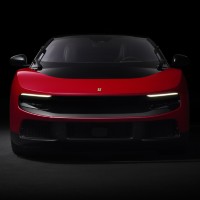
Ferrari entered the battery-electric era with a bespoke, zero-compromise platform designed to translate the brand’s historic motorsport pedigree for high-performance electric driving but upset almost everyone in the process.
Read full Ferrari EV strategy guide
Platform & EV Strategy
Rejecting shared platforms, Ferrari developed an in-house 880-volt skateboard architecture constructed from 75% recycled structural aluminium. The battery pack sits low between the axles, with 85% of modules integrated directly into the floor to optimize the centre of gravity and chassis stiffness. Power comes from a bespoke quad-motor setup with two motors on the front axle that can automatically disconnect for improved efficiency, and two high-RPM motors at the rear mounted on the cast-aluminium subframe. System output reaches 1,035 horsepower in boost mode, with real-time vectoring managed by Ferrari Side Slip Control X.
Current Lineup & Market Positioning
Ferrari operates strictly in the ultra-luxury, high-performance segment. The brand does not produce budget hatchbacks, executive saloons, or commercial fleets. Its flagship electric vehicle, the Luce, is a low-slung, five-seat liftback priced just under £500,000. It occupies a unique space above high-performance luxury saloons and not quite at low-volume electric hypercars, targeting collectors and buyers seeking a more exclusive Ferrari.
Real-World Usability & Charging Tech
Equipped with a massive 122 kWh battery, the Luce delivers a range of 329 miles. Efficiency is aided by active aerodynamic shutters and ride-height logic that lowers the chassis by 10 mm at high speeds to minimize drag.
- Charging Performance: Thanks to its high-voltage architecture, the system supports DC fast charging up to 350 kW, enabling a 10% to 80% charge in approximately 20 minutes.
- Software & Tactile Integration: Rather than relying entirely on touchscreens, the cabin retains physical, weighted mechanical dials and switches. Drivetrain audio is managed without artificial engine noise; mechanical vibrations from the axles are captured, equalised, and amplified into the cabin to provide real-time acoustic feedback to torque shifting.
Reliability, Warranty & Buyer Outlook
Because high-stress electric powertrains face unique thermal loads during repeated track use, Ferrari designed the battery modules with internal cooling plates capable of absorbing up to 500 kW of power during intense driving without thermal degradation.
To protect long-term residual value, the battery module is fully removable and repairable, allowing individual sub-assemblies to be serviced without replacing the structural floor pan. Factory-backed coverage options protect the high-voltage components, while Maranello’s strict production limits ensure strong resale stability, protecting owners against the steep depreciation curves common in mass-market luxury EVs.
Electric Cars: