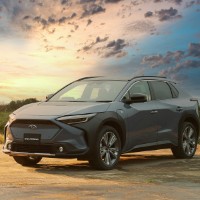
Subaru’s entry into the electric vehicle landscape remains conservative, relying heavily on partnerships to adapt its rugged, adventure-ready identity for a zero-emission future.
Read full Subaru EV strategy guide
Platform & EV Strategy
Subaru’s electric journey centers on the e-Subaru Global Platform, an architecture co-developed with Toyota. While this is a dedicated, bespoke EV platform rather than adapted from ICE, it is fundamentally a shared effort. Subaru’s distinct engineering contributions shine through in the software of its dual-motor setup and signature X-Mode off-road traction. This allows for instant torque vectoring across both axles, ensuring genuine light-off-road performance. However, sharing the platform means Subaru inherits both the advantages and the packaging limitations of Toyota's underlying hardware.
Current Lineup & Market Positioning
Unlike broad-range automakers offering everything from urban hatchbacks to executive saloons, Subaru’s electric portfolio is tightly focused. The Solterra serves as Subaru’s sole fully-electric offering, competing in the highly contested C-SUV segment. It is in direct competition with premium rivals like the Hyundai IONIQ 5 and Kia EV6, despite offering a much lower real-world range. Positioned purely as a niche option for outdoor enthusiasts who require standard all-wheel-drive, Subaru lacks the breadth needed to capture mainstream volume.
Real-World Usability & Charging Tech
Equipped with a 71 kWh battery, the Solterra delivers an official range of 289 miles. In real-world conditions, particularly at highway speeds or in cold weather, efficiency drops noticeably, making long-distance touring less practical than its competitors. Peak DC fast-charging tops out at 150 kW, allowing a 10% to 80% charge in roughly 35 minutes under ideal conditions. Software integration is clean with a responsive central touchscreen with wireless phone mirroring, but the instrument layout relies on an awkward elevated display that can be obscured by the steering wheel.
Reliability, Warranty & Buyer Outlook
Subaru benefits from Toyota’s thermal management and battery health, meaning long-term battery degradation should be minimal. The vehicle is covered by a 3-year / 100,000-mile manufacturer warranty, paired with extended 8-year protection on the battery. Depreciation remains a challenge. Steep prices, coupled with average real-world range, mean used Solterras experience significant depreciation over time. For buyers looking at long-term ownership, however, its durable cabin and capable all-weather mechanicals make it a sensible second-hand prospect once the value drops.
Current Electric Cars: