Ford’s position in the EV market is marked by partnerships, commercial vehicle dominance, and a structural transition toward a low-cost EV strategy.
Read full Ford EV strategy guide
Platform & EV Strategy
Ford relies on many platforms across its lineup. Its early bespoke effort, the GE1 architecture for the Mustang Mach-E, was derived from the internal combustion C2 platform. To scale rapidly in Europe, Ford partnered with Volkswagen for their MEB platform. This created the Explorer EV and reborn Capri. Meanwhile, commercial vehicles like the E-Transit use shared multi-fuel architecture. To secure long-term profitability, Ford is transitioning toward its next-generation "Universal EV Platform" developed internally, prioritizing simplified manufacturing, 48V zonal electronics, and LFP battery chemistry.
Current Lineup & Market Positioning
Ford covers several key segments, though its approach varies by region:
- Urban & Compact: The Puma Gen-E serves as an entry-level crossover, bringing electric driving to the popular B-segment.
- Family & Mid-Size SUVs: The European market is anchored by the MEB-based Explorer EV and Capri crossovers. Internationally, the Mustang Mach-E sits in the mid-size executive crossover category, targeting premium buyers seeking sporty performance.
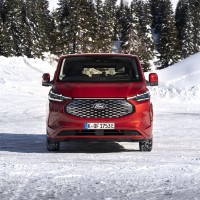
- Pickups & Commercial Fleets: Commercial vehicles remain Ford's strongest competitive fortress. The E-Transit, E-Tourneo Custom, and E-Tourneo Courier dominate light commercial electric fleets.
- Saloon Gap: Ford lacks any form of sedan, choosing instead to focus resources on higher-margin crossovers, SUVs, and vans.
Real-World Usability & Charging Tech
Real-world efficiency across Ford's lineup is respectable. The MEB-based Explorer and Capri offer competitive energy consumption and ranges up to 389 miles. Charging capabilities vary: while smaller models charge at peak speeds of 100 kW, the Mustang Mach-E and MEB family achieve 150 kW to 183 kW peak DC fast charging. On the software side, Ford's SYNC 4A infotainment provides clean routing with integrated charger planning. Ford's adoption of the North American Charging Standard (NACS) for native Tesla Supercharger access greatly improves real-world usability in the US.
Reliability, Warranty & Buyer Outlook
Ford’s initial electric rollout faced typical early-adopter challenges, however, current production models display improved build quality and a much better user experience.
Standard battery warranties cover 8 years or 100,000 miles at 70% capacity health. Depreciation reflects the broader EV market; first-generation models experience steep initial value drops, making used examples attractive, whereas commercial variants like the E-Transit hold residual values remarkably well due to robust fleet demand and lower operational costs. Overall, Ford’s strategic pivot to low-cost architectures positions it well for future mass-market adoption.
Current Electric Cars:


Electric Vans: