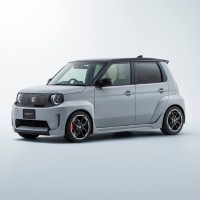
Honda’s electric vehicle trajectory seems pretty bleak, stripping away ambitious global strategies to focus strictly on hyper-affordable, ultra-compact urban cars.
Read full Honda EV strategy guide
Platform & EV Strategy
Having abandoned both the modified ICE architecture of its early models and the dedicated 0 Series platform, Honda’s current EV technology relies entirely on a back-to-basics, lightweight, front-wheel-drive city architecture tailored for low production costs. Rather than chasing modular platforms that scale across multiple body styles or support long-distance battery packs, this streamlined framework prioritizes low weight and minimal footprint. It trades range, structural flexibility, and complex multi-motor setups for extreme simplicity and manufacturing economy.
Current Lineup & Market Positioning
With the fashionable Honda e and the lackluster e:Ny1 crossover both phased out, and the 0 Series Saloon and SUV projects permanently cancelled, Honda’s fully-electric portfolio has shrunk to a single model: the Super-N.
- Entry-Level Urban Hatchbacks: The Super-N occupies the entry-level tier, aimed directly at budget-conscious city drivers seeking a stylish, motorsport asthetic.
- Saloons, SUVs & Commercial Fleets: Honda offers zero electric saloons, multi-row family crossovers, or commercial electric fleets.
Real-World Usability & Charging Tech
Real-world usability is strictly localized to short urban commutes. The Super-N utilizes a tiny 28 kWh battery pack delivering a range of just 128 miles, which drops to around 110 miles in mixed conditions and roughly 80 miles on highways. Energy efficiency is a strong point thanks to its light 1,097 kg curb weight but with such a small battery, this isn't really noticeable. Charging performance also remains minimal: peak DC rapid charging caps out at 50 kW, requiring roughly 30 minutes for a 15–80% top-up. Inside, the cabin relies on a 9-inch touchscreen running Honda CONNECT with wireless Apple CarPlay and Android Auto, retaining physical steering wheel controls and simple air conditioning readouts rather than complex software.
Reliability, Warranty & Buyer Outlook
Honda’s reputation for simple, robust mechanical build quality works in its favor here, as the stripped-back powertrain leaves fewer complex electronic components to fail. Battery longevity should benefit from low thermal stress, backed by a standard 8-year/100,000-mile warranty for 70% capacity retention. From a buyer outlook perspective, the Super-N avoids the catastrophic depreciation. Its sub-£19,000 entry point creates a low floor for resale values, making it a sensible low-cost city runaround, though its severely limited range and single-model lineup leave Honda far behind in the EV market.
Current Electric Cars: