

Renault has engineered one of the most compelling turnarounds in the EV market, blending heritage-driven design with sharp pricing to deminate the electric market.
Read full Renault EV strategy guide
Platform & EV Strategy
Renault’s success relies on dedicated architectures development through its Ampere division. Smaller models sit on the AmpR Small platform, which shares up to 50% of its components with the combustion CMF-B platform to keep production costs low while delivering bespoke EV advantages like a completely flat floor and a low center of gravity. Larger passenger cars use the AmpR Medium platform, a ground-up, long-wheelbase electric architecture. While its light commercial vehicles still sit on adapted multi-fuel foundations to maximize load volume, Renault's core passenger car lineup strictly uses dedicated, electric-first engineering.
Current Lineup & Market Positioning
Renault covers virtually every budget and use case across the market:
- Urban & Small Hatchbacks: The Twingo E-Tech is an ultra-affordable city car. Positioned just above it is the retro-styled 5 E-Tech, offering up to 252 miles of range.
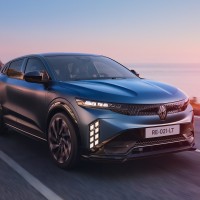
- Crossovers & Family SUVs: The 4 E-Tech adds rugged utility, providing up to 248 miles of range. The Megane E-Tech targets compact hatchback buyers, while the Scenic E-Tech acts as the brand's flagship family SUV, boasting a larger 87 kWh battery that delivers up to 379 miles of range.
- Performance & Vans: The radical 5 Turbo 3E showcases high-output drift-focused electric performance. For commercial fleets, the Kangoo E-Tech and Master E-Tech handle urban and heavy-duty logistics with fully electric drivetrains.
Real-World Usability & Charging Tech
Efficiency across the lineup is excellent, with lightweight hatchbacks like the 5 E-Tech regularly achieving 4.2 to 4.7 mi/kWh in real-world mixed driving. Charging is competitive rather than ground-breaking: AmpR Small models top out at 80 kW to 100 kW DC, while AmpR Medium vehicles peak at 130 kW to 150 kW, achieving a 10% to 80% top-up in roughly 30 minutes. Renault's standout feature is its software integration. The OpenR Link infotainment system natively runs Google Built-In for Google Maps route planning with automatic battery pre-conditioning before rapid charging stops. Bidirectional charging also allow owners to power external devices from the vehicle's battery.
Reliability, Warranty & Buyer Outlook
Renault backs its entire electric vehicle range with a standard 5-year/100,000-mile vehicle warranty alongside an 8-year/100,000-mile battery health guarantee promising at least 70% capacity. Early Megane and Scenic models have shown strong overall reliability, though minor software bugs occasionally affect the infotainment system. While rapid market-wide EV depreciation remains a factor across the industry, Renault’s aggressive pricing strategy means its newer EVs suffer far less upfront value drops than premium rivals, making them exceptionally strong options on both new and used markets.
Electric Cars:




Electric Vans:

