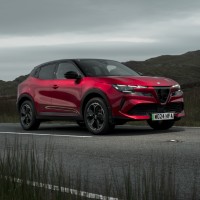
Alfa Romeo is blending its century-old Italian motorsport heritage with full-electric driving, attempting to prove that soul and sharp dynamics can survive the shift away from internal combustion engines.
Read full Alfa Romeo EV strategy guide
Platform & EV Strategy
Rather than engineering dedicated, single-use EV platforms from scratch, Alfa Romeo relies on Stellantis’ multi-energy architecture. Its entry-level EV, the Junior, uses the e-CMP2 shared platform, which accommodates both fully electric and mild-hybrid powertrains. Looking ahead to larger flagship models, Alfa Romeo will pivot to the STLA Large platform. While marketed as a dedicated BEV platform with 800V capability, ultra-fast charging, and high-density batteries, STLA Large remains a flexible, multi-fuel base capable of supporting combustion engines alongside pure electric drivetrains. This shared approach maximizes cost-efficiency but prevents fully optimizing the interior packaging the way bespoke EV platforms do.
Current Lineup & Market Positioning
Alfa Romeo’s all-electric footprint remains heavily concentrated at the entry point of the premium market.
- Entry-Level & Urban Hatchbacks: The brand’s sole fully-electric offering is the Junior Elettrica. Positioned as a stylish, premium B-segment urban crossover, it targets city buyers seeking distinctive styling. It is available in a standard 156 hp trim and a performance-focused 280 hp Veloce variant featuring a mechanical Torsen limited-slip differential for heightened driver engagement.
- Executive Saloons & Family SUVs: Alfa Romeo currently lacks a presence in these critical sectors. Pure-electric replacements for the Giulia saloon and Stelvio SUV, built on STLA Large, are scheduled to anchor the brand's mid-size executive presence in the future.
Real-World Usability & Charging Tech
Equipped with a compact 54 kWh battery, the Junior Elettrica delivers a range of up to 255 miles (410 km) on the standard powertrain, dropping to roughly 207 miles (334 km) in the higher-output Veloce. Real-world motorway driving highlights its limitations, where high-speed efficiency drops sharply and caps practical long-distance range. Charging performance is average for its class: DC fast charging peaks at 100 kW, enabling a 20% to 80% top-up in roughly 27 minutes. AC charging operates via a standard 11 kW onboard charger. Software integration centers around a driver-oriented 10.25-inch central infotainment touchscreen alongside a classic Cannocchiale digital instrument cluster, featuring EV route planning, ChatGPT voice assistance, and over-the-air updates.
Reliability, Warranty & Buyer Outlook
Historically plagued with mechanical and electrical reliability problems, Alfa Romeo leverages standardized Stellantis batteries, motors, and software in its new EV era to drastically improve this. Buyers receive a standard 3-year/unlimited-mileage manufacturer vehicle warranty alongside an 8-year/100,000-mile battery degradation warranty guaranteeing 70% capacity. While the brand’s design appeal and limited EV supply help immediate depreciation better than mass-market rivals, high retail prices and rapid technological advances across the EV sector mean buyers should still see steep early-year depreciation.
Electric Cars: